Tampilkan postingan dengan label sw history behind the film. Tampilkan semua postingan

Selasa, 25 Juni 2013

Snow White at RKO Keith's Theatre, 1938

From collector Rick Payne comes this original photograph of the RKO Keith's Theatre in Dayton, Ohio during the 1938 showing of Snow White.


The photo is interesting for several reasons. Here's Rick's observations...
The line of people waiting to get in wraps completely around the corner of the building despite the inclement weather. You can see that there are some kids in line, but most of those waiting appear to be adults. It's a daytime showing and I don't know the day or date - weekday or weekend? There's a theatre exit on the right side of the building with a Snow White marquee.


Also, a Snow White horizontal fabric banner hangs under the main entrance marque, but unfortunately, it's mostly hidden from our view.


In another photo of Keith's, a similar hanging banner is seen for the Mickey Mouse cartoon "HAWAIIAN HOLIDAY".

Images and info courtesy of Rick Payne via dadric's attic.


That's quite a crew of ushers; those were the days!

Senin, 29 April 2013

1940 Walt Disney Festival of Hits Pressbook

PRESSBOOK FRONT COVER


In an effort to raise much needed funds for the studio, Snow White and the Seven Dwarfs was brought back to theatres in the summer of 1940 after having been "retired" just one year earlier. The Great Walt Disney Festival of Hits was a compilation release of five Disney films. The four shorts included Ferdinand, The Bull, The Practical Pig (a Three Little Pigs sequel), The Ugly Duckling, and Donald's Lucky Day.


Festival of Hits pressbooks are difficult to come by, as are the posters and lobby cards. This re-release was very popular with audiences and did quite well, but it only played to a limited number of theaters, making the promotional materials all the more rare.

The book contained a total of eight pages including covers. Dimensions 12" x 18". Content included newspaper copy for stories about all the films, but it focused mainly on Snow White as would be expected...

CLICK IMAGES TO ENLARGE


Print-ready newspaper ad layouts.


More newspaper copy...


On the back cover, an array of poster sizes that could be ordered by theatre owners. A set of eight lobby cards was also available. Four of the cards were for Snow White and one each for the others titles.

Image scans courtesy of the Michael Filippello Collection.


The Great Walt Disney Festival of Hits continued to play at select theatres throughout the rest of 1940 and even into March 1941.

Minggu, 28 April 2013

April 29, 1939 - Last Day Before Snow White Closes

It was at the conclusion of this day, 74 years ago, that the Disney brothers would "retire" their multimillion dollar cash cow.
In the spring of 1939, after a record-breaking worldwide run of more than a year, Snow White made headlines once again when the Disney studio pulled it off the market. RKO exchanges were informed that the film would no longer be available for bookings after 29 April. JB Kaufman's The Fairest One of All, p.266.

This Australian newspaper clipping from The Morning Bulletin (Rockhampton, Queensland) dates from April 26, 1939, just days before Snow White's first run would come to a close. The article included press copy about the making of the movie plus an illustration. From the introductory paragraph, it's clear the film had previously screened in Rockhampton but was returning on this date for three final days at the Wintergarden Theatre.


Images via Trove.


At the time, Snow White's viewership was still strong and probably would have continued on for a good while. Walt and Roy knew, though, that the more it remained in the public eye, the less value the motion picture would have in the long run. So they did the unprecedented and stopped things while they were still ahead. Sending films to 'rest a spell' in the Vault is something Disney has done better than any other studio over the years. This may have been what the brothers had in mind back then, but what they probably didn't plan for was a return of the movie the very next year.

It's well-known that in North America, the first stand-alone RKO reissue of Snow White and the Seven Dwarfs occurred in 1944. Yet as early as 1940, with the less-than-hoped-for box office returns of Pinocchio, the high production expense of Fantasia, the costly studio move to the new Burbank location, and the looming loss of revenue in wartime Europe, the Disney boys found themselves once again in need of a real influx of income.

So it was that The Great Walt Disney Festival of Hits was conceived to bring Snow White out of her brief retirement and back to the big screen for a limited run. It would be the highlight of a reissue package that also featurted four other Disney films--Ferdinand the Bull, The Practical Pig, Donald's Lucky Day, and The Ugly Duckling.

Tune in for tomorrow's Archive entry to see the complete 1940 Festival of Hits pressbook.

Sabtu, 02 Maret 2013

RKO Newsette, March 3, 1938

Although Snow White and the Seven Dwarfs had its 1937 premiere in Los Angeles, the rest of the world would still have to wait a while before seeing the film. It took time for Technicolor to churn out enough release prints to meet demand. In addition, RKO slowed the distribution process by requiring exhibitors to make special, higher-than-usual priced bookings for their engagements. The result was an erratic, yet still very enthusiastic general theatrical release.

A few first run theaters were showing the movie as early as January. It opened at Radio City Music Hall in NYC on January 13, 1938 as well as at the Sheridan Theater in Miami. Argentinean audiences were some of the first to see it internationally with a January 22 premiere in Buenos Aires.

Disney's official general release date was February 4, 1938. Yet, there weren't enough prints made by Technicolor to cover the second run or neighborhood theaters until later. Also theaters were studio-owned back then, and it was not unusual for a film to be "held over" a few weeks before being sent on. This might explain the March 3rd "opening" we see in the flyer below (due to the extended Radio City engagement).

Movie theaters that ran RKO films would hand out to patrons a type of herald called the RKO Newsette. This free 4-page paper carried bits of Hollywood news and trivia, but it also served to promote upcoming releases. A rare treasure, this particular issue (Vol. XXI; No. 16) dates from exactly 75 years ago today and announces the March 3rd opening of Snow White at the RKO 58th Street Theater in NYC.


[CLICK IMAGES TO ENLARGE]


Special thanks to Michael Filippello for sharing the RKO Newsette info and images from his Snow White collection.

Selasa, 29 Januari 2013

"Heigh Ho" Deleted Segment from Original 'Snow White' Soundtrack

We continue with our look into the Snow White songs released on the 1938 soundtrack record as they compare with those found in the movie. In addition to The Silly Song (previous post), the other track worth noting is Heigh Ho.

Record image courtesy of the Rick Payne Collection via dadric's attic.

Heigh Ho follows Dig-a-Dig-Dig on Side B of the first disc of the three-record set. Of course, we know they also run back-to-back in the film; the dividing point between the two occurs when we see the clock strike five and Doc calls out "heigh-ho!"


Both record and theatrical-release of Heigh Ho are identical up until 44 seconds into the song. In the movie, Dopey has just put the vault key on the nail, and he runs to catch up with the others on their homeward journey.


The record version then continues on with about 18 to 20 seconds of a whistling melody which is not included in the movie sequence. Animation for this segment was planned, but due to time considerations, it was cut.

Listen to the record excerpt here...


The remainder of the "Heigh-Ho" song is the same as what we hear in the film when the Dwarfs march home to the cottage for the first time.


This whistling melody, however, was not left out completely. It was brought to my attention by Snow White enthusiast, Nunziante Valoroso from Italy, that it did indeed make it into the final movie. It was simply moved to the last reel of the film and occurs in the scene right before the animals arrive at the mine to warn the Dwarfs about the Witch. They whistle the tune while they're pulling a mine cart.


_____________


After comparing the other songs from the 1938 record set with what is in the movie, I happened to notice another minor anomaly. At the conclusion to One Song, when the Prince is singing to Snow White from below her balcony, she sends a dove down to him to deliver a kiss.


The dove blushes while sitting on his hand. In the picture, a dove "cooing" sound effect was inserted at this point. On the record album, it was not. All of the other dove intonations, though, do seem to be in place on the soundtrack disc.

Screen captures and audio excerpt copyright Disney. Included here for historical documentation purposes.

Minggu, 27 Januari 2013

"Silly Song" Deleted Lyrics from Original 'Snow White' Soundtrack

If you were to do a side-by-side comparison of the original 1938 Snow White soundtrack record (RCA/Victor three-disc set) with the songs heard in the actual movie, you'd find that the two recordings are generally the same...but not identical. There are some really interesting differences. Of course, the audio we have in the film today has all been digitally remastered, but the variance we're about to explore is not related to sound quality.

I first became aware of these discrepancies after reading a 2011 article on the subject by Cartoon Brew contributor Eric Graf. Eric discovered that a set of lyrics included on the record and sung by Sneezy in the Dwarfs' Yodel Song (aka The Silly Song) are not in fact in the movie. There was discussion as to whether or not this deletion of content occurred because of censorship. The thought was that the lines in question might have been slightly too racy for a 1938 audience. However, Snow White author/historian JB Kaufman commented on the post and said the scene 'wasn’t censored, just cut for time considerations. It never made it in the Technicolor cutting continuity, dated January 1938.'


The disc label from the first 78 rpm record of the Dwarfs' Yodel Song. Note that it is not referred to as The Silly Song.

Record image courtesy of the Rick Payne Collection via dadric's attic.


The Yodel Song from the original soundtrack recording (OS) runs a little over three minutes (3:15). The version used in the theatrical-release (TR), although missing the deleted lyrics, still calculates out to be more than a minute longer (4:25). The exact lengths actually depend on where you mark the endings to the songs. For consistency, let's agree that both tracks conclude right after Snow White laughs and says, "That was fun." Now we're ready for the side-by-side comparison.

As we know, the sequence in the film begins with an exterior shot of the Dwarfs' cottage before pushing in on the party inside. Good music and lots of cheer welcome us in as Happy (dancing with Dopey) steals the initial few seconds of the show with his fancy moves. The Dwarfs are singing the yodeling refrain.
Ho-la-la-ee-ay
Ho-la-la-ee-ay
Ho-la-la-ee-ay-ee-la-ee-ay-ee-lee-ay
Ho-la-la-ee-ay
Ho-la-la-ee-ay
Ho-la-la-ee-ay-ee-la-lee-ay-lee-o-lee-ay

Happy is then the first to sing a verse.
I like to dance and tap my feet
But they won't keep in rhythm.
You see, I washed them both today
And I can't do nothing with 'em.

Up until this point, 51 seconds into the song, both versions are the same. Now the two begin to diverge.

Immediately following Happy's lyrics, he does a kind of a soft-shoe while Snow White watches from the foreground and Bashful and Doc play instruments in the corner.  In the OS, we hear the princess laughing during Happy's funny moves. Strangely, this laughter track is not included in the TR even though we can clearly see her laughing on screen.


This scene is also the first time we hear the "Silly Song" chorus...or do we? Certainly in the film, the following lines are sung with both Bashful and Doc moving their mouths to the words.
Ho hum the tune is dumb
The words don't mean a thing.
Isn't this a silly song
For anyone to sing?
I was really surprised, however, to learn that the OS does not include this chorus. The melody is there, but it's performed by a banjo and clarinet rather than vocals. This would explain why on the original record label, The Silly Song title is absent. The "Silly Song" lines were not included anywhere in this version.


At about 59 seconds, we come to Sneezy's deleted scene. In the OS, his lyrics go as follows.
A minute after I was born
I didn't have a nighty.
So I tied my whiskers around my legs
And I used them for a didee.
The last word, didee, is delivered in conjunction with a classic sneeze from Billy Gilbert who was the voice of Sneezy. This entire section was cut and not included in the final film and thus is not found in the TR.


Both versions now go into Dopey's drumstick segment (the sticks pass through his sleeves), the OS at the 1:25 mark and TR still at 59 seconds. It's followed by Bashful's lines.
I chased a polecat up a tree
Way out upon a limb,
And when he got the best of me
I got the worst of him.


We run through a couple more yodeling refrains including a Happy solo; Snow White hits her operatic soprano note and dances with Doc, Bashful and Sneezy; Dopey and Sleepy go through their "house fly" gags.

The Dwarf's Yodel Song comes to an end in the OS with the tweeting of the wooden bird whistle on Grumpy's organ. It's followed by laughter and Snow White's "That was fun" line. The total running time is 3:15.


In the film, the song keeps right on going. Instrumental music, hand clapping, and shouts of "Hey!" fill the room, all while we watch the dancing sequence with Dopey on Sneezy's shoulders.


After Sneezy explodes with another sneeze that shoots Dopey to the rafters, everyone enjoys a laugh for about 12 seconds at the conclusion of the song. Snow then gets to say "That was fun." The running time of the TR version totals 4:42.

Screen captures and audio excerpts copyright Disney. Included here for historical documentation purposes.


_____________


Listen to a short audio excerpt which includes Sneezy's deleted lyrics from the original soundtrack recording, plus Dopey's drumstick segment (released January 1938).


_____________


On January 9, 1938, Billy Gilbert performed his Sneezy role during the Mickey Mouse Theater of the Air radio program. We hear the deleted lyrics again, but in a slightly different form.
When I was born so long ago
I felt so high and mighty.
I tied my whiskers around my legs
And I used them for a ...di, a...dee, a...doo [sneeze!]
...for a nightie.
This deviation and the song's finale are included below. Also listen for Mickey Mouse when he says Walt Disney is dancing with Snow White. In radio-land, anything can happen.


_____________


During the Lux Radio Theater performance of Walt Disney's Snow White, December 26, 1938, Billy Gilbert's back as Sneezy. This time he sings the original deleted lines except he ends with "nightie" again rather than "didee".


_____________


A few of the informative comments on the 2011 Cartoon Brew post...


Eric Graf on October 31, 2011 at 9:34 am said:
Most early Disney songs have verses that are in the sheet music and/or popular recordings of the songs, but weren’t used, or even intended, for the movie. For instance, this scary looking record, released in 1955
http://www.ebay.com/itm/Vintage-45-RPM-Record-Walt-Disneys-Magic-Kingdom-songs-/120493888218
contains the...Yodel Song verse, as well as [another] verse that never made it into the movie in the first place:

“I used to have a billy goat/ we had him disinfected./ He could have slept in Grumpy’s bed/ but the billy goat objected.”

____


Greg Ehrbar on October 31, 2011 at 10:26 am said:
The “billy goat” lyric was sung by Jimmie Dodd, who performed the song, along with Tommy Cole and Kevin “Moochie” Corcoran, on a Mickey Mouse Club LP called A WALT DISNEY SONG FEST that was reissued as WALT DISNEY’S MOST BELOVED SONGS.

____


Jeff Kurtti on October 31, 2011 at 4:57 pm said: 
When I was doing the Platinum DVD of “Snow White,” we had all manner of trims, outs, and camera tests that had been found over many years by Scott MacQueen. I’m not sure the additional lyric was ever actually animated, but may have been cut prior to that.

There is evidence that the film was tweaked several times after the premiere at the Carthay Circle and well into its initial release, I believe it was “locked” in its currently-known form only on its first reissue in 1944.

____


Eric Graf on October 31, 2011 at 6:50 pm said:
This link: http://78records.cdbpdx.com/SWSR/ has the film-to-record transfers being completed between November 26 and December 17, 1937. The Murray reference book on Disney records says the contract between Disney and RCA was signed on December 7th, so presumably it would’ve been near the end of that range. Would they still be making changes to the soundtrack that close to the December 21 premiere?

____


JB Kaufman on October 31, 2011 at 8:35 pm said:
Sneezy’s verse was animated (by Les Clark), but Steve Segal is right: it wasn’t censored, just cut for time considerations. (It doesn’t appear in the Technicolor cutting continuity, which is dated January 1938.) For what it’s worth, Sneezy did sing his verse in two radio broadcasts after the film was released: “The Mickey Mouse Theater of the Air” in January 1938, and the “Lux Radio Theatre” the following Christmas. In both instances, the word “didee” was interrupted by a sneeze.

____


JB Kaufman on November 1, 2011 at 5:58 pm said: 
I don’t think the scene is lost, exactly, but to my knowledge it exists only as pencil animation. It was in the picture as late as October 1937 — sweatbox notes reveal that Clark was still revising it at that date — but I believe it was cut before reaching the ink-and-paint phase. As far as I can tell it’s not possible to watch it.

____


David Gerstein on November 2, 2011 at 10:27 am said:
When the British MICKEY MOUSE WEEKLY comic book published the lyrics to “The Silly Song” (in issue 126, 1938), they included [another] version of Sneezy’s lost verse:

The minute after I was born
I didn’t have a nightie;
I used my beard to keep me warm,
And tied it round me tightly!

____


Mac on November 2, 2011 at 1:45 pm said:
It could be that the lyric wasn’t changed in the comic for reasons of censorship, but simply because British audiences wouldn’t know what a didee was. I can’t speak for Brits who were around in the the late 30′s, but I’ve never heard anyone use the word didee over here and we call ‘diapers’ ‘nappies’.

____

Jeff Kurtti on November 2, 2011 at 8:48 pm said:
We were not able to find any other test or pencil footage while doing the DVD edition (pretty much everything we could find was put on the disc, even though some of it is very short, or the context takes more time than the actual footage!). And BELIEVE me, the Home Video Marketing folks would have loved nothing more than to tout more “lost” footage ;-)


Tune into the next post as we examine the original Heigh-Ho track.

Selasa, 08 Januari 2013

January 9, 1938 - Mickey Mouse Theater of the Air

The Mickey Mouse Theater of the Air was a short-lived Sunday afternoon radio program on NBC. A children's musical variety show, the half hour broadcast was recorded in front of a live studio audience at the Disney Little Theater on the RKO lot. Initially, Walt Disney was skeptical of a weekly presentation featuring his characters; he didn't believe they would translate well into this non-visual medium. Pepsodent tooth paste, however, was offering a weekly sponsorship outlay of ten to twelve thousand dollars, and that's probably what got the show the green light. Yet, Walt's instincts were correct. Looking back, the programs are certainly interesting from a historical perspective, but they do lack a little something in entertainment value.

In all, there were 20 episodes that ran from January 2 to May 15, 1938. It's not difficult to see how Walt aspired to use this platform to help promote his recently premiered Snow White and the Seven Dwarfs. With the film scheduled to open at New York's Radio City Music Hall on January 13, 1938 and then into general release across North America on February 4th, a weekly radio show would only help to enliven the buzz.

Every episode incorporated Snow White's talking Magic Mirror as a means of teleporting the Disney characters into their adventures. The gang would drop in on Mother Goose, King Neptune, The Pied Piper, Cinderella, Sleeping Beauty and many other storybook tales.

Image via 2719 Hyperion.


The January 9, 1938 Program:

Today's episode, the second in the series, was entitled "Snow White Day". Our host John Hiestan was joined on stage by Walt Disney as himself. Walt also voiced Mickey Mouse (a role he continued for only the first three episodes; Mickey's radio duties were then turned over to actor Joe Twerp). Other characters included Minnie Mouse (Thelma Boardman), Goofy (Stuart Buchanan, who voiced the Huntsman in the film, and possibly Grumpy here) and Donald Duck (Clarence Nash).

The opening theme was Who's Afraid of the Big Bad Wolf? performed by the Felix Mills Orchestra, followed by an instrumental of Whistle While You Work. Additional vocals (and bird sounds) were provided later in the show by the twelve-member, all-female Minnie Mouse Woodland Choir, plus their counterparts, an eight-member male choir.

We learn from Mickey, Minnie, Goofy and announcer Hiestan that Donald has been locked in the attic (although he turns up later). Walt then asks Goofy to bring out the Magic Mirror, after which Mickey invokes it to 'bid Snow White and her Prince to appear.'

Snow comes on to sing I'm Wishing followed by the Prince's One Song. When I first heard these numbers, I thought the vocals were performed, as they were in the film, by Adriana Caselotti and Harry Stockwell. I still think the Prince's voice may be Stockwell. However, after many more listenings, I'm leaning towards the idea that Snow White is played by Thelma Hubbard. Hubbard would have this role for certain eleven months later on the Lux Radio Theater.

Walt continues a narration of the Snow White story which leads into her singing With a Smile and a Song. Mickey then invokes the Mirror once again, this time to bring forth the Old Witch, Lucille La Verne. It's a terrific little moment between her and Walt when she approaches with a basket of apples and says, "Hello Disney! Have a bite?!"

Later, the Seven Dwarfs arrive on stage singing Heigh-Ho (the male choir) before being introduced to the audience. Again, the voice-actors sound a bit anomalous to what we're used to in the movie. Pinto Colvig, aka Grumpy and Sleepy, surely had been replaced since he'd already left the Studio in 1937. Yet all the others could be here: Roy Atwell (Doc), Otis Harlan (Happy), Scotty Mattraw (Bashful). Certainly Billy Gilbert is Sneezy. He practically steals the show with his nasal antics. The whole gang is then transported to the Dwarfs' cottage where they perform the Silly Song.

The program's showstopper was a version of Some Day My Prince Will Come where both Snow White and the Prince sing to each other. Things wrap up with a final Pepsodent plug before Walt tells us what to expect in next week's show. Then it closes with an instrumental of With a Smile and a Song.

Thanks to musical director Felix Mills, we can now listen to this episode in its entirety. His estate donated the original recorded discs from the radio show to the Pacific Pioneer Broadcasters...


Special thanks to Jim Korkis for his invaluable knowledge of this subject. Learn more about Mickey Mouse Theater of the Air in Jim's article posted on MousePlanet. You can also hear seven out of the original twenty episodes which have been uploaded to the Internet Archive.

Kamis, 20 Desember 2012

75th Anniversary of Snow White's World Premiere

December 21, 1937. It was on a Tuesday evening 75 years ago that Walt Disney unveiled to the world his great feature-length experiment, Snow White and the Seven Dwarfs.

The Carthay Circle Theatre was located at 6316 San Vicente Boulevard in Los Angeles. The theartre itself was set back off from the road. This allowed plenty of space for all the crowds and commotion that occurred over the years at its many festive movie premieres.

Aerial photo circa 1926


The Blue Carpet...

The Snow White screening was scheduled for 8:45 pm. Hollywood celebrities who attended that night were dropped off at the street curb. From there they would walk down the blue (not red) carpet which stretched under a canopy all the way to the theatre doors.

1937 Snow White Premiere. Image via D23.


The theatre grounds were transformed for the big night and included a towering Christmas tree placed to the right of the canopied walkway.

 Press Release scan courtesy of the David Lesjak Collection via Vintage Disney Collectibles.


The Snow White Garden...

Closer to the theatre was a flower garden populated with character figures.
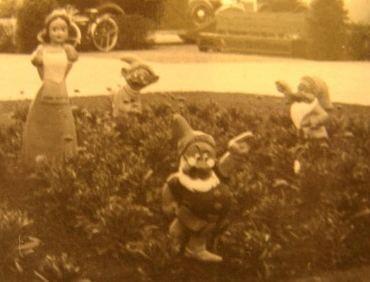


Snow and the Dwarfs look on from their garden plot.


The photo below would have been snapped looking west from under the canopied walkway.


The Art Exhibit...

On the opposite side of the walkway was a covered exhibit featuring images and info on the film.


Set atop the roof of this pavilion were large papier-mâché heads of the princess and all the dwarfs. Along the bottom lattice were more figures. According to researcher David Lesjak, these appear to be point-of-sale store display pieces manufactured by Disney licensee Old King Cole.

Art Exhibit photos courtesy of the David Lesjak Collection via Vintage Disney Collectibles.


The exhibit included photos from the making of the film.


Drawings and layouts.


Also cels.


Well before opening night, tickets were being offered by the Disney studio to members of the motion-picture industry and for sale to its own employees. At $5.50 a person, the admission was roughly five times the price of a regular screening for an adult. (See an original Snow White ticket stub from the Whittier Theatre in an earlier post.) The capacity of the Carthay Circle was around 1500 people, and the premiere had been sold out for some time. Yet many thousands still gathered outside, a good number of whom waited eagerly in a long line at the advance tickets box office to purchase seats for future showings.


The Grandstands...

Several sets of bleachers were erected and packed with onlookers. One section ran out to San Vicente Boulevard in front of the Security First National Bank. A spotlight truck was parked nearby.

 Press Release scan courtesy of David Lesjak Collection.


A larger crop of this photo reveals trolly tracks and overhead wires running down the street, probably the main means of transportation for the average moviegoer back in 1937.


Another row of grandstands was placed adjacent the street curb next to the entrance of the canopied walkway.


A motley-looking crew of dwarfs pose for a picture with the walkway and second set of stands behind them. The ramp in the foreground leads to a raised platform where NBC announcer Buddy Twiss was stationed to catch interviews with the arriving celebrities.


A third set of bleachers sat inside the Carthay courtyard, behind the garden plot and facing the theatre entrance.


And a fourth ran perpendicular to it.


Looking from the stands towards all the action...


For crowd control, a higher than usual number of Los Angeles police officers were brought in along with the theatre's own security team. Some theatre employees probably wore identifying ribbons like the one seen in an earlier post. Usherettes were dressed in Snow White costumes.


The Stars...

Snow White brought out the Hollywood royalty. Among them were Marlene Dietrich and Douglas Fairbanks Jr., fresh off their Lux Radio Theater performance of The Song of Songs from the previous night.


Comedians Jack Benny, Mary Livingstone, George Burns, and Gracie Allen.


Fred MacMurray with wife Lillian Lamont (left); Preston Foster (right).


Shirley Temple with friends, parents and dwarfs.


Comedian Bob Burns with the Seven Dwarfs...


Other celebrities included Charlie Chaplin, Clark Gable, Carol Lombard, Cary Grant, Judy Garland, Ed Sullivan, Charles Correll and Freeman Gosden (of Amos and Andy fame), John Barrymore, Frank Capra, Spencer Tracy, Ginger Rogers, Charles Laughton, Elsa Lanchester, George McCall, Paulette Goddard, Gail Patrick, Joe Penner, Helen Vincent, Fred Perry, Norma Shearer and many more.


Walt arrives.


The Radio Broadcast...

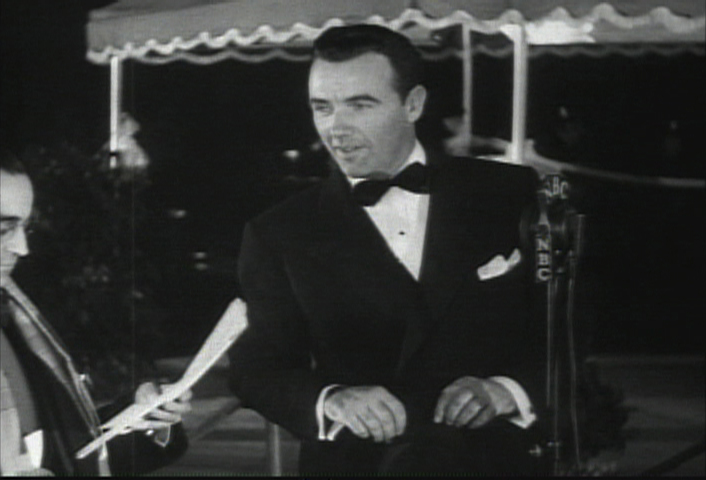
Live coverage of the event came by way of a half-hour radio broadcast on the NBC Blue Network. Announcers Don Wilson and Buddy Twiss described the evening's festivities, stopping to hear comments from the Hollywood elite as they walked by. As mentioned above, a slightly raised platform was placed near the entrance to the canopied walkway where Twiss would speak with celebrities. Wilson was located closer to the orchestra's band stand.

Scripts had been prepared for both Walt and Supervising Director David Hand to use. It's clear that Hand reads directly from his. Yet Walt, talking with Buddy Twiss, sort of just wings it and humorously can't remember all the names of the Dwarfs.

Image via The Fairest One of All by JB Kaufman, p.232.


Immediately following Walt's radio interview, Buddy Twiss tries to turn it over to Don Wilson, but he pauses and says, "Just a moment." After a few seconds of dead air, he finally sends us back to Wilson who is waiting with voice actors for Minnie Mouse (perhaps Marcellite Garner or Thelma Boardman) and Pluto (probably not Pinto Colvig who left the Disney Studio in 1937 following a fallout with Walt). Mickey then joins in, most likely voiced by Walt himself. This would explain the delay in the broadcast from Buddy Twiss.

Another clue that Walt is Mickey on this night is in his response when Wilson asks, "Mickey do you wish you were in the picture?" The mouse replies. "Not me. I need a rest." The gang is then joined by Clarence Nash voicing Donald Duck.


Possibly the first-ever costumed Mickey, Minnie and Donald were also on hand.


Another shot of the mice reveals that on this evening, both were being played by women. To the left in the photo is the backside of a spotlight positioned to shine in the direction of Buddy Twiss as he interviewed the celebrities.

Image courtesy of Daveland.


The Orchestra...

Don Wilson spoke about the orchestra that night and how it was the same Disney ensemble which had recorded the music for the picture. The one notable exception being that this live performance was directed by big-band leader Manny Harmon rather than composers Franck Churchill or Leigh Harline.

In regards to the orchestra's location, I seem to have more questions than answers. When Wilson introduces the show, he says that he's right beside the band stand. To his left is the box office "advance window" where a long line of fans wait to buy tickets for future screenings. To his right is the canopied walkway which stretches out to the street. These remarks would seem to place him and the band very close to the theatre entrance. Yet is this correct?

Although this aerial photo is dated roughly eleven years prior to the premiere, circa 1926, we still get an idea of where everything was situated. I have marked two possible locations for the orchestra, "A" and "B". (Also take note that the art exhibit was set in the side courtyard between the theatre and the back of the building which faced San Vicente Boulevard. This building did not exist in the 1926 image so I Photoshopped one in.)


Initially, I was picturing Don Wilson and the orchestra at location A. Looking from San Vicente Boulevard, it would have been to the left of the walkway and close to the theatre, sort of near the art exhibit. This seems to fit with Wilson's description, especially since he said the box office window was to his left. However, not much exists in photographic evidence to support this idea. From the few images we have of the area, it looks as though the police security wasn't letting the general public approach the theatre entrance, and the main ticket windows don't appear to have the long lines that Wilson described. Yet it's difficult to say for sure without more photos.


Location B is another possibility. Here the orchestra may have been stationed closer to the street, up against the wall of the Security First National Bank. The photographic evidence for this is not great either, yet there does appear to be some.

In this first image, we can see what looks like a temporary canopy with hanging mesh curtains next to the building. What purpose would this canopy serve except to protect the musicians from the elements? The curtains are closed, but it seems as though there might be musical instruments or other equipment next to them.


Zooming in a bit closer, we see what could be a few men in penguin suits seated out in front of the curtain. Members of the orchestra? We also get a better look at the gentlemen standing near the Christmas tree. It's likely that one of these is Buddy Twiss. Could the fellow just to the left of the glaring light be Don Wilson? Can't say for sure.


If this canopy was indeed where the orchestra was set up, what about the advance ticket window that Wilson mentioned was to his left? Could it actually have been located on San Vicente Boulevard, perhaps behind the grandstands? This is just speculation, but it's possible that a temporary box office could have been arranged in this area since it would have been most accessible to the crowds that night.


In this next pic, the mesh curtains are now completely opened. Does this indicate that the radio broadcast is underway and the orchestra is now playing? Is that music director Manny Harmon conducting?


Just recently I was contacted by collector Michael Filippello who owns the original 1938 Snow White pressbook. Pages 2-3 of the book highlight the successful Carthay Circle premiere.


And pictured clearly under the canopy is the 40 piece orchestra. We have our answer!

Pressbook scans courtesy of the Michael Filippello Collection.


The orchestra performed a number of instrumentals throughout the evening including Whistle While You Work and The Dwarfs' Washing Song. In addition, the same choral singers from the film sang Dig, Dig, Dig and Heigh-Ho.

At about 10 minutes into the program, and after several celebrity interviews with Buddy Twiss, the broadcast went back to Wilson who introduced the next piece, With a Smile and a Song. He states that "it will be sung for us tonight by Snow White herself." And indeed, it is Adriana Caselotti who's there to sing live, but she's never mentioned by name.

As we saw in the Carthay Circle Playbill (earlier post), Walt did not want to identify the actual voice actors from the film. He felt it would "heighten the audiences' acceptance of the voice as part of a character" if the actors were not associated with the roles they portrayed. As a result, both Adriana Caselotti and Harry Stockwell that evening were referred to by Don Wilson simply as Snow White and the Prince.

Harry sang One Song and Adriana returned to perform Some Day My Prince Will Come. After that, the two of them went to get their tickets at the box office. In a story often told by Caselotti in later years, the attendant said that their names were not on the list. The stars of the film not only went uncredited for their work, they also went uninvited to the premiere!

"Tickets? We don't have any tickets. I'm Snow White and this is Prince Charming!" The attendant, of course having no idea who these two were, refused their request. They were forced to step aside. Yet Adriana, always full of spunk, waited until no one was looking. Then the two quietly slipped inside and upstairs to watch the premiere from the balcony.
Adriana Quote via SWATSD: The Making of the Classic Film by Brian Sibley and Richard Hollis, pp. 35-36.

______________


Now relive the gala premiere by tuning into the entire half-hour NBC radio broadcast (audio only)...


_______________


Walt and Lilly Disney inside the theatre.

Image via The Fairest One of All by JB Kaufman, p.232.


The screening without question was a massive success. The animators who attended were often quoted on just how amazed they were by the emotional and enthusiastic response their film elicited. The audience applauded and cheered throughout and gave a spirited standing ovation at the movie's conclusion. Walt stepped out on stage with his wife and said, "I always dreamed that one day I would attend a gala premiere in Hollywood of one of my cartoons. Tonight you've made it come true. You make me feel like one of you."

The buzz inside the theatre was electric, so much so that folks didn't want to leave. People hung around the lobby for an hour after the movie had ended trying to put into words what they'd just experienced.

Animator Ken Anderson once told Disney historian Paul Anderson...
We were never prepared for this type of reception. And boy they were crowding around Walt. And each of us. They crowded all around, 'What did you do?' And such and such. We're standing out there in the foyer and these people just went on and on and on and on about this marvelous picture.

What a night it was! Happy 75th Snow White...and many more!

_______________


Watch the short RKO newsreel on the Snow White premiere as seen in the extras from the 2001 DVD release...

Video posted by fireurgunz


An excerpt from the 1938 RKO release, How Walt Disney Cartoons Are Made, also featured a few newsreel clips from the premiere...


This brief footage of Walt walking down the blue carpet was "flopped" in the RKO film...


Special thanks to David Lesjak of Vintage Disney Collectibles for supplying invaluable information about the premiere plus a number of the images seen here. Also to Jim Korkis for his assistance and the article A Snow White Christmas Premiere. And to Brian Sibley and J.B. Kaufman for their kind input too.

For more on the buildup to the premiere, see the earlier Dwarfland post.