Tampilkan postingan dengan label frank thomas. Tampilkan semua postingan

Selasa, 21 Februari 2012

Frank Thomas - Disney's Nine Old Men

Frank Thomas (September 5, 1912 - September 8, 2004) attended Stanford University where he began his lifelong friendship with future "old man" Ollie Johnston. He also met two other students there who he'd end up working with at the Disney studio--animator James Algar and layout artist Thor Putnam.

Frank and Ollie, Standford campus 1932...


After graduation, Thomas went onto study at the Chouinard Art Institute in Los Angeles along with Putnam and then Johnston. Algar was the first to be hired at Disney, but the others followed not long after, Frank on September 24, 1934.

As was the norm, he started out as an in-betweener where he worked for six months. During this time, he was among a select group of beginners asked to attend the after-hours classes now being taught at the studio by Don Graham (who was promoted to full-time instructor the same day Thomas was hired). Walt was gearing up for Snow White and he wanted his animators ready for the task.

Frank became an assistant to Fred Moore, and his drawing skills excelled as he moved from simple clean-up to full animation work. He also picked up valuable tips and advice from the likes of Ham Luske, Les Clark and Wilfred Jackson. After about a year, Frank advanced to junior animator, and his pal Ollie took his place as assistant to Moore in March of 1936.


He'd been working at the studio for a year and a half, but Thomas still hadn't met Walt Disney. That changed with Frank's work on the Silly Symphony Little Hiawatha. The "boss" liked what he saw and soon after, the young animator was one of eight artists chosen to draw the seven dwarfs under the supervision of Fred Moore (and Vladimir Tytla).

In the scene where Snow White tells the dwarfs to wash up before dinner, Thomas noticed that the story sketches for the scene suggested that Dopey walked with a "hitch step" in order to keep pace with the others. So he added it. Frank said, "You were always looking for some way of making the character come to life, enriching him, making him a little different." Walt saw the addition in the pencil test and loved it, "Hey we oughta use that hitch step throughout the picture." All scenes of Dopey walking had to be redone. More than one angry animator would privately let Thomas know what they thought of his "brilliant" idea.


Two of the most powerful scenes in the movie have Frank's magic touch upon them. He animated the cottage sequence with the dwarfs grieving over the still body of Snow White...


...and also in the forest as they kneel on the ground around her bier. This last one in particular was a crucial moment in the film. No one in the studio knew for sure if the audience would feel for these "cartoon" characters. The animation had to "realistic, sincere, believable action."


In a 1973 interview with John Canemaker, Frank talked about the process of getting the right look for these scenes...
I made a lot of drawings. Are [the Dwarfs] better looking straight ahead? Are they better grouped together two or three looking around? And, of course, you always have help. Someone in story sketch, someone like Albert Hurter, or Don Da Gradi will make drawings. Don was great at getting the essence of the character. If it was sad, he'd make twelve drawings of a sad guy. You'll only use one in your scene, but you're ninety percent there. Frank Thomas, Nine Old Men p.178


When it came to the animation itself, Thomas wanted to keep the movement of the Dwarfs in check...
...not too much because this is sad and you want minimum movement; but in 'sincere' animation you find out if you do not move the character he goes flat and it kills it, and you can't make your point. In doing a sincere thing, in order to believe this guy is real, he's up there feeling this part, you have to keep him moving.
Frank Thomas, Nine Old Men p.178


Not all of Frank's animation made it into the final film...
A scene of Dopey collapsing in tears into Doc's shoulder was cut in half when a preview audience laughed; Dopey's face held an uncharacteristically pained expression which the audience misinterpreted. The final version begins as his face is nearly buried in Doc's shoulder and continues through his shoulder-heaving sobs.
John Canemaker, Nine Old Men, p.179


Possibly the most touching moment in the film is when we see Grumpy break down and bury his head in his hand. "The only Dwarf with a major body move," said Thomas.


Frank Thomas went on to animate dozens of Disney films and became one of the great animators of the Golden Age. He retired from the studio on January 31, 1978.

Research on Bambi...

Frank Thomas photos and sketches via John Canemaker's Walt Disney's Nine Old Men and the Art of Animation, 2001.
Snow White image scans copyright Disney.

Further reading:

    Selasa, 31 Januari 2012

    The Nine Old Men

    1958 Photo: left to right, Kimball, Larson, Thomas, Davis, Johnston, Clark, Kahl, Lounsbery, Reitherman

    Much has been written about the Nine Old Men and their larger-than-life animation achievements. These were not the first talented artists to work for the Disney Studio, yet they certainly became it's creative core for more than 40 years.

    Probably the most definitive work on these 'conquistadors' of the Golden Age is John Canemaker's book, Walt Disney's Nine Old Men and the Art of Animation (Disney Editions, 2001, ISBN-10: 0786864966).

    Front Cover

    Canemaker recounts how Walt jokingly nicknamed this dream team after President Roosevelt's description of his contentious 1937 Supreme Court, "nine old men, all too aged to recognize a new idea."

    Newspaper Cartoon, February 9, 1937, Brooklyn Citizen via New Deal Network.

    Of course, the animators were neither old nor afraid of new ideas. Quite the opposite, they would be the leaders, taking the art of animation to new heights.

    The Nine Old Men were:

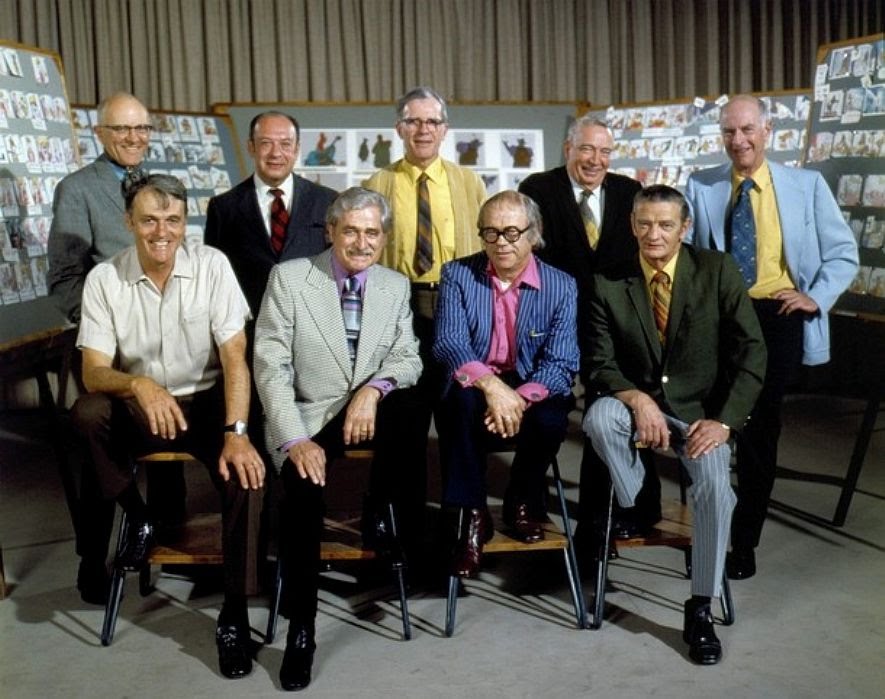
    1972 Photo: left to right, Kahl, Reitherman, Davis, Clark, Thomas, Kimball, Larson, Lounsbery, Johnston

    Animator Les Clark was the first to be hired in early 1927. The rest of the group came in between 1933-35, just as things were heating up for the making of Snow White and the Seven Dwarfs. From 1935-37, all nine of the very young "old men" would be involved.

    Throughout this month, we'll take a closer look at what each contributed to the film and in what capacity they served the animation factory that was the Disney Studio of the late 1930s.

    Further reading:

    Selasa, 27 Desember 2011

    "An Art in Its Making" - The Book


    Front Cover and Spine

    Stephen Ison's animation art collection is beautifully reproduced in the 1994 Walt Disney's Snow White and the Seven Dwarfs: An Art in Its Making. The 192-page hardcover features loads of stunning full-color images of the artwork along with an introduction written by Steve and text by Martin Krause and Linda Witkowski.


    Synopsis by Gordon Flagg of Booklist magazine...
    Krause provides a critically incisive account of making the film, from its inception through its three years in production to its wildly enthusiastic reception by audiences and critics. Witkowski supplies a detailed, fairly technical explanation of the animation process as well as a guide to the preservation and handling of animation art designed to appeal to serious students of the genre. The heart of the volume is a retelling of the famous story scene-by-scene by means of cel reproductions, pencil drawings, and other production art.

    _______________________


    From an email correspondence with Steve earlier this year...

    Filmic Light: How did the Snow White...An Art in Its Making book come about?
    Stephen Ison: It started out to only be a catalogue for the exhibition. I kept pounding on the museum “powers that be” that it needed to be a book. I won...especially after Hyperion Press wanted to publish it.

    FL: Did you know authors Martin Krause or Linda Witkowski before the book?
    SI: Yes. Linda Witkowski was the person I had known who helped/taught me about conservation and preservation of animation art. She had actually done her college Masters thesis on cel restoration and conservation. Linda introduced me to Marty who helped me convince the IMA that an exhibition of art from Snow White could be successful.

    FL: How much were you involved with it?
    SI: Pretty much, every aspect, whether they always welcomed it or not.

    ________________________


    The opening of the 1994 Indianapolis Museum of Art exhibit featuring Steve's collection was quite an event. Diane Disney Miller attended along with animator greats Ward Kimball (along with his wife Betty), Marc Davis, Joe Grant, Ken O'Connor, Maurice Noble, and Bill Justice. What an opportunity it was for the attendees to meet and chat with these legends...and to get autographs.

    The title page from the book below comes from the Phil Sears Collection. It features the signatures of all of the animators mentioned above. In addition, it's signed by Frank Thomas and Ollie Johnston who could not attend the Indianapolis event due to an illness that Ollie’s wife was suffering from.

    Signed Title Page. Book sold for $499 (USD) on August 30, 2010. Image via Phil Sears Collectibles.
    [CLICK IMAGES FOR A BETTER VIEW]

    _______________________


    Steve's collection encompassed a wide range of animation art including "master backgrounds, concept art, cels, drawings, studio notes, character models, and various other items associated with the film." Here's a just a few of the dynamic images found within this handsome book.

    Layouts and storyboard drawings...


    Backgrounds and watercolors...


    Cel set-ups...


    Images copyright Disney/Hyperion Press/Stephen Ison

    _______________________


    In 1995, a "Disney Miniature Edition" was published. Same book, same number of pages, just smaller in size.

    Front Cover, miniature edition

    While both the original and miniature versions are no longer found via new bookstore channels, they are available from online resellers, often for a decent price. On a side note, it was about a decade ago that I stumbled upon a stack of 15 to 20 brand new shrink-wrapped copies of the full-size original, all dramatically reduced in price at a Barnes and Noble. I couldn't resist...I bought them all.

    Original Edition:
    Hardcover, 192 pages
    Published by Hyperion Press (September 23, 1994)
    ISBN-10: 0786861444
    ISBN-13: 978-0786861446
    Measures 10.9" x 9.6"

    Miniature Edition:
    Hardcover, 192 pages
    Published by Hyperion Press (November 3, 1995)
    ISBN-10: 0786861878
    ISBN-13: 978-0786861873
    Measures 5.5" x 4.7"